Saturday, 20 December 2014

Goodbye, Caribbean!

The day after we arrived in Cartagena we went to explore the old town, the city's main attraction. It's a really nice, well-preserved Colonial town, surrounded by a wall you can walk around on. We walked around the walls a bit, got icecreams and visited a couple of bookshops, but most things were quite expensive so nothing more.

Statue of a vulture?


There was a whole bunch of these guys round doing a whole bunch of different things.


These tags are from Getsemanì, the cheaper neighbourhood near the walled-off centre.


We then spent a couple of days sitting around in the hostel being generally hot and not doing much. Halloween happened around then, so we went to the market to buy a variety of delicious tropical fruits (who knew how many kinds of tasty-as-fuck passionfruit-like fruits there are?) which we juiced and mixed with rum.

After Callum and Ariel went to Medellìn, I went to this place:
How to take photo of thing with weird shadow :/

This was, for a few years, the centre of the Inquisition in Latin America. However I think it was mostly an administrative centre, because now, while it's a museum full of torture devices, most of them say on their sign that they weren't actually used in the building. But fuck it, it was interesting, so here's some creative ways to hurt people:

Scale to find out if you're a witch.

I probably should've taken photos of what these things are actually for...
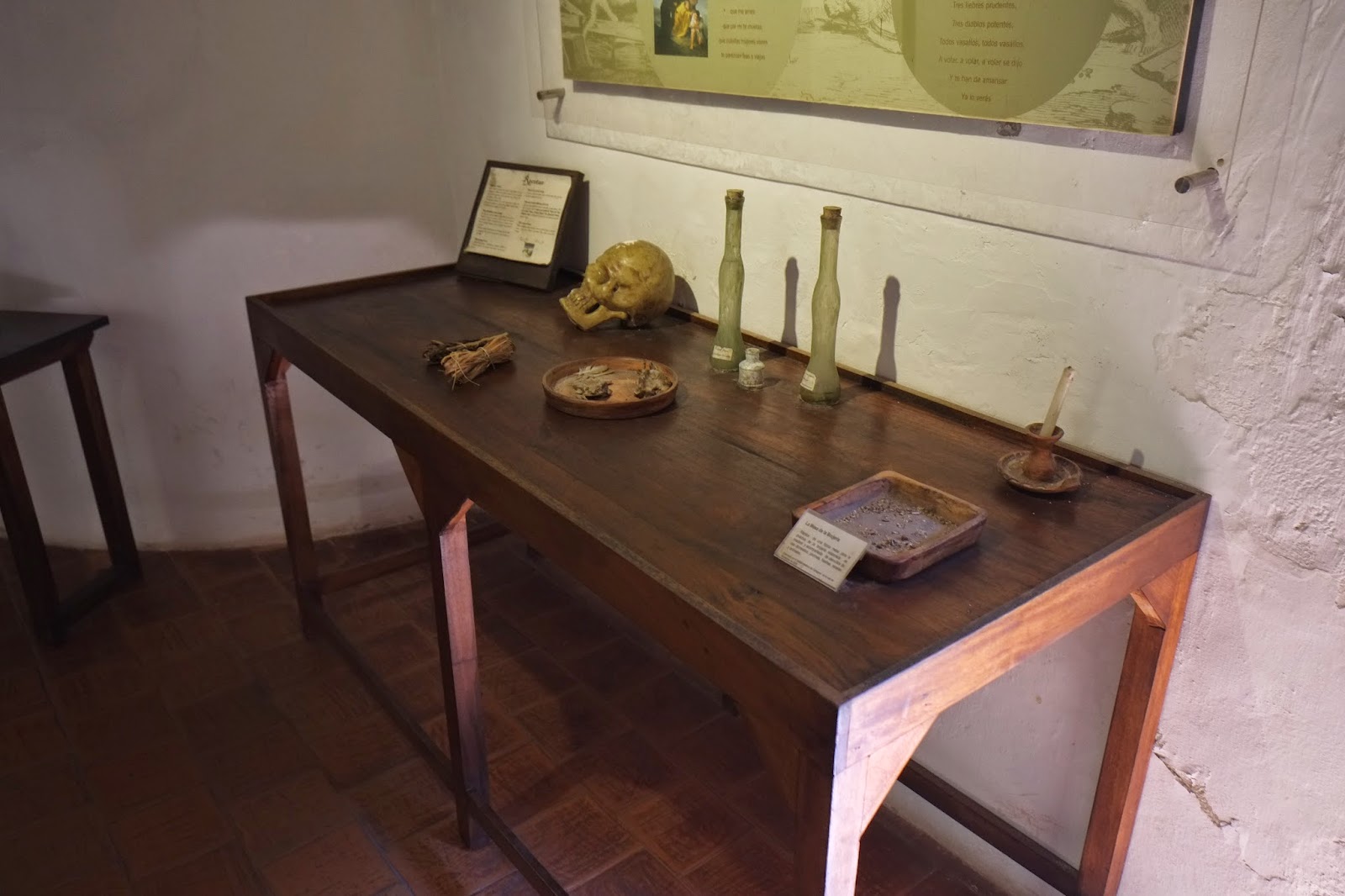
Table of witchcraft


I'm pretty sure this thing was for crushing chins.
This one was for crushing fingernails.


Person-stretcher.


A nice necklace.


This guy had problems with drawing eyes I think...

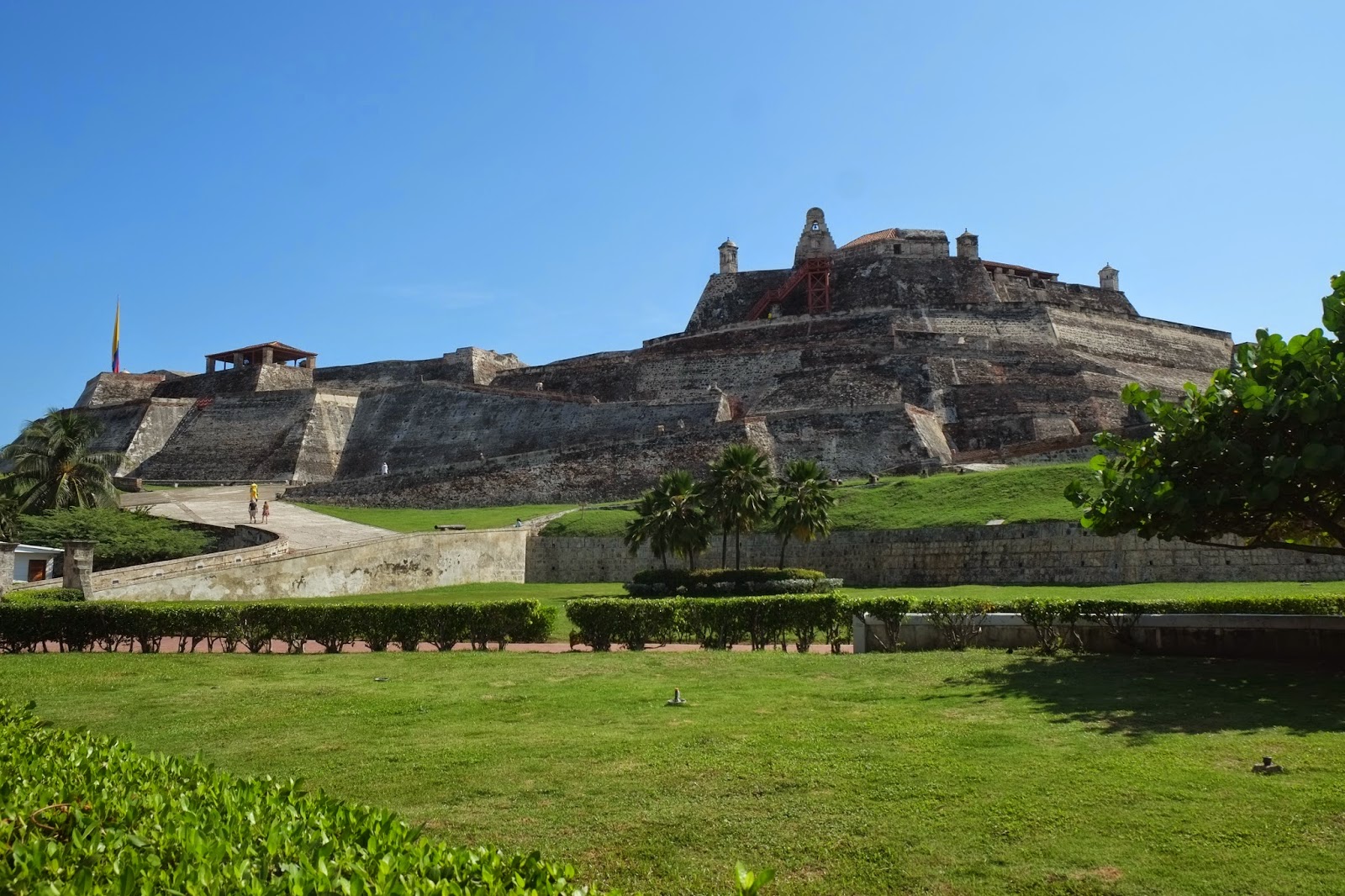
The next day I visited the Castle of San Felipe de Barajas. This was built by the Spanish to fight pirates, and was never taken.


Wish I'd known about this. I'd never consider trying to see the Royal Family in NZ, but would've been all over it here!


One of the more interesting things about the castle is the whole thing is full of tunnels. Unfortunately, there isn't much in said tunnels.


Old-school hospital


The day after the Castle, I left Cartagena for Santa Marta, which doesn't have much going for it except as a stopping point for the rest of the Caribbean Coast. I stayed a night there then started the 4-5 day trek to the Ciudad Perdida (Lost City).

The trek started in a small town called El Mamey (themselves.   Pelea: machete fight). The first day was about 4 hours up a hill then down the other side.

Top of the hill.

A lot of the path was like this. Luckily we got basically no rain, but it'd be hellish if it was wet.

Our stop for the first night. There was a cool little waterfall we could jump off, and much delicious food to be had.

The 2nd day was about 7 rarely-flat hours to reach the camping place before the ruins themselves.

Traditional village, currently empty. They only really use their villages when they have meetings and celebrations and so on, and spend the rest of the time on their fields munching on coca leaf. 


Who needs a tripod? 


The 3rd day started off pretty easy, until we came to the entrance of the ruins, which is 1200 steps. Even without rain they were slippery, and I can't even imagine making the things 400 years ago...

Near the entrance to the ruins. The majority of the ruins are circles like this, which were the bases for houses or whatever was needed. The ones near the entrance were the market area I believe.


Much of the site had to be reconstructed. Some archaeologist said there should be a wall at the top of the photo and it was built before they realised it was a staircase. Silly archaeologists. 

More fucking stairs.


This is what life's about. The location was truly breathtaking. Anyone got some spare hair though? :( 


Due to recent (though I'm not sure how recent) guerrilla activity, there's about 60 soldiers permanently posted at the ruins. 


If I remember correctly the guide said these were the punishment unit for the locals. If they broke rules they'd have to live in these houses away from their families, and were assigned hard physical work. The men are also deprived of their coca leaves. 


This guy didn't think he could make it all the way back so he hired a mule for the last 2 days. 

The chef saw this guy and excitedly took photos with all our cameras. 

Our last swim, of which we had many. 

After the trek, I stayed a couple of days in Santa Marta, not realising that my next destination was so close. The bus to Taganga from Santa Marta is about 15 minutes over a hill, so I had most of a day free. I'd read about the dive safaris offered by one dive shop in town, Calipso Divers, so I signed up for one with the intention of staying a few more days in Taganga then heading up the coast further. Because I arrived a day later than the safari left, the next day I got driven in to the park on an old road that's been torn up by years of abusive bus drivers. Then the boat took me to where I was staying, the then-deserted Playa del Amor (beach of love). I did 2 dives during the day that day, and 1 at night, and completely fell in love with diving again. Being able to chill on the empty beach and read and chat was the icing on the cake.


Epic hammock from La Guajira, a really remote desert peninsula near the border with Venezuela. Apparently they cost about NZ$400, but this one cost 2 dive courses. 

The second night, after more dives, I chatted with the owner of Calipso, Roberto, who told me about the logistics of operating so deep in the national park, and the politics of being able to do so. Essentially they're the only dive shop that's allowed to due to some combination of tradition and the fact that they ran a coral restoration program, where they grew broken fragments of coral into pieces that could be transplanted back into nature. However, sometime in the last few years the national park management decided they didn't want to continue investing and cut off the project. Naturally Roberto was pissed off coz he just wants to carry on, and now that it's all established doesn't even need their money, but despite that they aren't keen to let him continue.

After a couple of days in Taganga, hanging out with all the cool cats there I went back and signed up for a 2-day coral specialisation program they have at Calipso, and during that trip, Roberto proposed that I stay on to do a dive master course and then work for him through the high season (which runs late December-late January). I thought about it a bit and signed up.

So I dove every day for a while, and had a blast hanging out with the folks in the hostel in Taganga (including a baller as fuck Thanksgiving Dinner) and drinking too much maracuyà juice.

A couple of weeks later a bit of shit happened, including me getting chikungunya (look it up, it fucking sucks) and being barely able to walk for a few days at a time, with fever and fatigue and so on. Supposedly the symptoms can come back every week or 2 for a few months, and I wasn't enjoying the diving so much, so I sadly left Taganga to travel to Medellìn with 2 good friends. This was an ordeal in itself, having to carry my pack and everything around when every step was agony, but here I am.

Maps

Arrival (13,500km): https://www.google.com/maps/d/edit?mid=zVbaYW-catC4.kCQX3nsVyUm4

Mexico (3,600km): https://www.google.com/maps/d/edit?mid=zVbaYW-catC4.kqRC5GuGoC-4

Guatemala 1 (970km): https://www.google.com/maps/d/edit?mid=zVbaYW-catC4.kNmM9YnEFi2k

Belize (580km): https://www.google.com/maps/d/edit?mid=zVbaYW-catC4.kF9iZHp05hME

Guatemala 2 (540km): https://www.google.com/maps/d/edit?mid=zVbaYW-catC4.kG7doD_7oM8M

El Salvador-Honduran Border (275km): https://www.google.com/maps/d/edit?mid=zVbaYW-catC4.k_uay4lijieU

Honduras (1,100km): https://www.google.com/maps/d/edit?mid=zVbaYW-catC4.kiqYSFhzH7wQ

Nicaragua (840km): https://www.google.com/maps/d/edit?mid=zVbaYW-catC4.kcgxkEuuOVOA

Costa Rica (530km): https://www.google.com/maps/d/edit?mid=zVbaYW-catC4.k3ULp7176Yy0

Panama (720km): https://www.google.com/maps/d/edit?mid=zVbaYW-catC4.kKMfZ7p6G2yU

Colombia (5,014km): https://www.google.com/maps/d/edit?mid=zVbaYW-catC4.keLn0K9OcQHk

Ecuador (4,828km): https://www.google.com/maps/d/edit?mid=zVbaYW-catC4.kyhFid5WHCVU

Peru (6,148km): https://www.google.com/maps/d/edit?mid=zVbaYW-catC4.k2bC1jeNZ4Dk

Bolivia (3,312km): https://www.google.com/maps/d/edit?mid=zVbaYW-catC4.kzAKdGjR69IM

Chile (3,494km): https://www.google.com/maps/d/edit?mid=zVbaYW-catC4.kA4KW_sPA7a8

Argentina + Chile 2 (5,112km): https://www.google.com/maps/d/edit?mid=zVbaYW-catC4.kLqvpUgeOju0

Total: 37,063km (or 18.7 times from Cape Reinga to Bluff on SH1)

w/ flights: 50,563km

Hello, South America!

After leaving Panama in the evening, we "set sail" (there was no wind for 5 days straight, so they had to motor the whole way). We sat and chatted with Cecile and Daniel for a while, then went to bed. They've been living on the Basta for several years, spending most of their time in Latin America writing about social issues and have some cool stories.

We woke up here:


After breakfast, we swam to the island in the top photo. I was thinking swim there, look around a little, swim back, so after 2 hours or so making a sand castle without sunscreen, we were all lobsters. We wrote "Fuck Pirates" on the sides of the castle's gate, so that's as close to a name as it's getting. This asshole tried to claim it:


The sunset that night was pretty cool too:


We chugged along through the second night too, and woke up in time to see the Farside Island:


We stopped in the middle of 3 islands similar to the guy below, and spent the day swimming and chatting, and went snorkelling while Daniel hunted dinner for us.


That night and most of the next day, we motored towards Mamitupu, the biggest island we visited, where Cecile and Daniel spend some of their downtime. Turns out I never took any photos of Mamitupu, then next ones in my camera are of the nasty as fuck blisters Callum had on his back when we got off the boat near Colombia and had to carry our packs.

In the evening we had dinner with Don Pablo, a friend of C&D's that runs the closest thing to a hotel on the island, a few comfortable little huts with a restaurant. That night we learnt a bit about life on the Kuna (the indigenous inhabitants) Islands. They people are self-governing, and live mostly in 3 comarcas, the biggest of which is the Kuna Yala, or Kuna Islands. The men of each island elects a saila, or chief, upon the death of the incumbent. The saila leads a weekly or twice-weekly congress in the meeting house in the middle of the island (all the paths are bordered by tall wooden stake fences, and don't have much sense to their design, so it's labyrinthine). He lies in his hammock and settles day-to-day disputes and issues with the running of the island, as well as serving as religious leader of the island by singing and reciting the Kuna history and tradition. His recitals are then interpreted by a group of advisors, as they're recited in a different version of the Kuna language. 

Despite the fact that each community is led by a man elected by men, the Kuna culture is reasonably matriarchal. All landowners are women, and land passes from mothers to daughters, and husbands move in with their wives, thereby contributing the the wife's family's welfare. Outsiders aren't allowed to own land or live on the Kuna Yala either, so all land is owned by Kuna women. 

Kuna culture is alive and strong, but that's not to say it hasn't been changing my modern conveniences. A few years ago, the Panamanian government helped furnish each home with a small solar panel, so each house has lighting, and some have radios or TVs. On Mamitupu, there was 5 or 6 little shops where you could buy coke and biscuits and whatever household necessities are necessary. Except there's no garbage disposal, so even though the islands are fucking beautiful, and the Kuna know that they live in a paradise, trash gets left around the edge of the island on the more populated islands. It's a huge shame, but there isn't really any solution short of sending around a boat to pick it all up, but that's not profitable so who's gonna do it? 

We spent most of the following day on Mamitupu, chatting a bit with the Kuna and reading and so on. Then early in the morning, we left Mamitupu to be dropped at Puerto Obaldia, the closest town to Colombia with Panamanian border control. There was only 3 little hotel-ey things in Obaldia, and all were full, so we set off along the beach to find somewhere to camp, only to be stopped at the military post on the path to the next bay. Turned out you can't walk between the bays at night or really leave the town, or you might trigger a military response to traffickers or paramilitaries or whatever. But the beach was supposedly safe, so we set up beds and chatted and watched the sunset with our last Panamanian beers...


In the morning someone offered a ride in his boat to Capurganà, the Colombian equivalent of Puerto Obaldia (there's 2 more towns in the bays between Capurganà and Puerto Obaldia: La Miel (the honey) for Panama and Sapzurro for Colombia). We negotiated a price, and told him we had to go to migration. When we arrived at migration, we were told we needed 2 photocopies of our passports each, and that the net cafes would be open. Neither of them were, so we waited outside until they were. The guy came out for a smoke while we were waiting and said to us that they were open. We told him no they weren't. He said it's 8:15, they open at 8, of course they're open. We told him no, we visited and they weren't open. Finally one opened and we waited another half hour in line for about 3 people, then returned to our friend with the boat and headed around to Capurganà. 

That day we didn't do too much - had our first Colombian bandejas, one of the only cheap non-fried things I've seen so far here. It's basically a plate with rice, a little salad, a fried plantain and your choice of meat. Pretty good really, but gets a little old after a month or so. The next day we walked to Sapzurro for lunch, then Callum and I continued on to the duty free store at La Miel to pick up some cheap rum. Shit's so expensive in comparison in Colombia. 

The following day we got a boat from Capurganà to Turbo, one of the motors of which decided it wouldn't work properly, so after half an hour or so we stopped for almost an hour while they fixed it. Then the first bus from Turbo to Cartagena broke down about 15 minutes out of its destination for about half an hour. Joyous day. But we arrived at Cartagena, and there was space in the hostel we'd chosen, so not a total disaster. 

Bonus pic: Callum's back: